
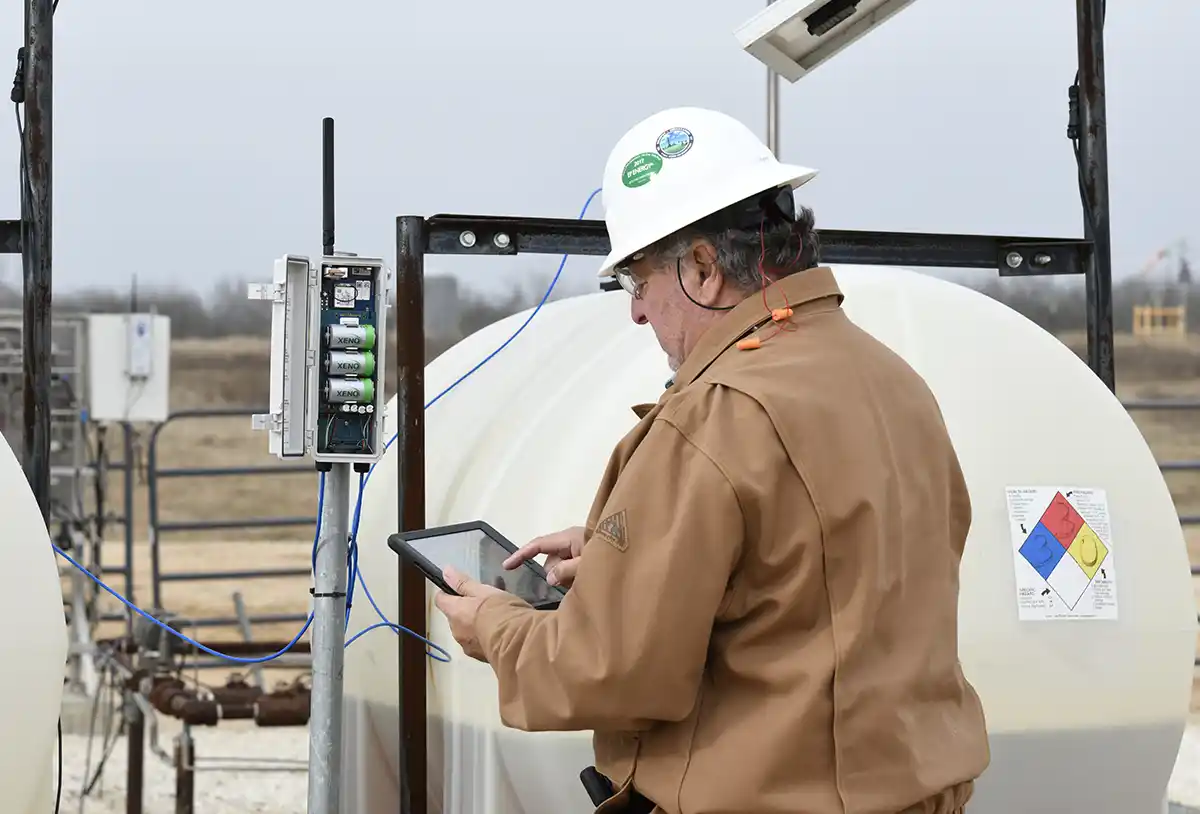
Chemical management has historically been an operationally complex function in oilfield production, industrial processing, and water treatment operations. It sits at the intersection of fluid delivery, mechanical reliability, power systems, remote logistics, and safety – all in the most rugged and remote environments and locations. But for decades, most chemical and fluid management programs have been managed reactively: trucks roll when something “looks wrong,” pumps are adjusted after production degrades or asset integrity issues arise, and troubleshooting often begins only once a technician is physically on location.
That model is changing with WellAware.
By leveraging the latest tech and combining low-cost, high-resolution edge data capture, SCADA-integrations, and automated diagnostic logic, WellAware is increasingly transforming chemical management from a field-driven guessing game into a data-driven, remotely managed system of record that delivers actionable recommendations before problems escalate, not after. This results in better operational outcomes, higher profitability, and most importantly, safer operations.
The Foundation: Strong Edge Visibility
Many automated chemical programs fail because they lack a reliable, high resolution, and complete data set. Traditional systems often capture limited, low-resolution, and inconsistent sensor variables while missing the granular operational context required to understand why a pump failed, why a tank emptied prematurely, or why a power system drifted out of tolerance.
WellAware’s edge platform closes that gap by continuously capturing and contextualizing:
- AC and DC power health
- Battery condition and charge behavior
- Pump runtime, duty cycle, and variance
- Tank level, pressure, and calibration status
- Valve position and flow consistency
- Remote control and calibration state
- Closed loop integration with existing SCADA systems and onsite automation
And much more
Critically, this data is captured at the source, normalized in real time, and transmitted cost-effectively making it seamless to deploy even across marginal wells or low volume injection locations, where traditional instrumentation would never make sense financially.
But raw data alone does not create value; it just builds the foundation.
Turning Signals Into Decisions: Automated Diagnostics and Recommendations
The real transformation occurs when edge data is paired with diagnostic logic and recommendation engines that translate all captured data into clear, operational guidance. Instead of just dashboards that require constant human interpretation, WellAware’s system generates predictive and reactive recommendations that tell operators what to do—and often what not to do—based on observed system behavior.
These recommendations also shift the paradigm away from reactive “run to failure” models wherein issues are only discovered on site after the failure has occurred to preemptive, preventative maintenance models. With WellAware’s proprietary AI/ML insights you can often detect a pump is failing weeks before it goes down, often even before injection variance has drifted from its intended range.
Power & Connectivity Intelligence: Know Before You Go
Power issues are one of the leading causes of chemical system downtime, yet they are also among the most time-consuming to troubleshoot in the field.
With continuous monitoring, the WellAware platform can distinguish between:
- AC/DC power loss vs cell connectivity loss → “Check GFCI or power system”
- Battery end of life warnings → “Replace depleted batteries”
- DC charging system degradation → “Check solar panels, solar charge converter”
- Voltage under load anomalies → “Excessive voltage draw under load—check pump and pump wiring”
This distinction matters. Knowing whether a pump stopped due to battery degradation or wiring issues versus a tripped GFCI can eliminate multiple unnecessary truck rolls and ensure the right parts arrive the first time. Batteries do not need to be replaced every time. Failing pumps give warning signs, and if identified and corrected preemptively you can prevent battery degradation and early failure.
Pump Performance: From Guesswork to Precision
Chemical pumps and set points are often adjusted manually based on assumptions rather than feedback. Over-injection wastes chemicals and money, and often contributes to further downstream issues when chemical injection and programs are not appropriately automated. Under-injection risks corrosion, scale, expensive workovers, downtime, and production loss. By analyzing variance, calibration state, pressure behavior, and motor status, WellAware enables real time recommendations and remote diagnostic actions so operations teams know why performance is off and what action will correct it in real time, often without sending a technician to site. Even more importantly, the system can flag predictive pump health anomalies before failure occurs, enabling planned maintenance instead of emergency response. This is of critical importance to extend the useful life of chemical pumps and optimize their performance – 80% of pumps operating without WellAware fail within the first 2 years of operation.
Tank Intelligence: Optimizing Remote Operations and Manage By Exception
Chemical delivery systems, supply chain management, and unnecessary field labor are among the most expensive aspects of delivering chemistry in the field.
Tank-level intelligence allows WellAware to identify conditions such as:
- Air-locked tanks → “Check tank valve; purge pump”
- Empty tanks → “Check pump and schedule tank fill”
- Invalid Calibration → “Tank calibration out of range, check sensor, re-do”
- Suspected leaks → “Check tank and lines for leaks; excessive fluid drop”
- Equalization valve issues → “Check tank valve; increase size if not plugged”
- Delivery Detected -> “Automated invoice and timestamp based on X gallons delivered”
The impact here is substantial. Avoiding unplanned tank run-dry events alone can prevent corrosion excursions, scale formation, and production downtime, while also reducing chemical waste and emergency resupply logistics. Most importantly, route and supply chain optimization are finally an achievable reality with WellAware’s reliable inventory insights.
Remote Control + AI-Assisted Diagnosis: Knowing the Problem Before You Dispatch
Perhaps the most underappreciated benefit of intelligent chemical management is diagnostic certainty. When a system flags that:
- A pump was intentionally stopped remotely
- A calibration is in progress
- A recent site adjustment occurred
…the recommendation engine explicitly tells the user not to take action.
This prevents redundant dispatches, conflicting adjustments, and unnecessary field exposure. Technicians are no longer sent to “see what’s wrong.” They are dispatched with clear intent, the right tools, and a known corrective action. As AI and machine learning models continue to mature, these same datasets form the foundation for:
- Automated root-cause classification
- Failure pattern recognition across fleets
- Prescriptive maintenance scheduling
- Continuous optimization of chemical dosage and uptime
The ROI Stack: Why This Model Scales
- When viewed holistically, the ROI of intelligent chemical management compounds across multiple dimensions:
- Uptime & Asset Integrity
- Fewer pump failures
- Fewer tank starvation events
- Earlier detection of power and wiring issues
- Chemical Cost Reduction
- Elimination of chronic over-injection
- Faster correction of under-delivery
- Reduced chemical waste from leaks and miscalibration
- Field Labor Efficiency
- Fewer unnecessary truck rolls
- Better-prepared dispatches
- Reduced back-and-forth troubleshooting
- Safety & Environmental Benefits
- Fewer site visits reduce exposure risk
- Lower fuel consumption and emissions
- Better documentation and auditability of operations
The result is not just incremental improvement; it is a structural change in how chemical programs are managed. The ROI impact is proportional to the way WellAware’s technology is integrated into our partner’s systems and workflows. It is not uncommon for WellAware’s customers to confirm saving 5-10 times what they spend on WellAware’s solutions.
Chemical Management as a Digital System
The future of chemical management is not more dashboards, more alarms, or more manual oversight. It is intelligent systems that translate data into decisions, delivered at the speed and cost required to operate at scale. By combining low-cost edge data capture, SCADA-integrated control, and automated recommendation engines, WellAware enables operators to move from reactive field response to predictive, remotely managed chemical operations driving measurable ROI through uptime, integrity, efficiency, and safety. Chemical management is no longer just about pumps and tanks. It is about optimizing the performance and maximizing the useful life of assets that are currently deployed, and knowing (and often fixing) what’s wrong before you head to the site.