
Why WellAware’s Closed-Loop Control Wins in the Real World
The problem
Injection variance measurement isn’t a lab problem — it’s a field problem.
Most injection sites face:
- changing back-pressure
- inconsistent power quality
- temperature-driven viscosity changes
- entrained gas
- fouling and coating
- installation variability
- pump wear and drift
The result: systems that look accurate on paper often drift over time, require frequent troubleshooting, or quietly report misleading injection numbers and that assumes they don’t fail in the field.
WellAware has spent over a decade refining a different measurement method that uses your existing hardware and proven analytics to give you confidence in every reading.
Two approaches — one is structurally more reliable
Approach A: “Measure frequently using extra hardware” Many competing systems attempt to improve measurement accuracy by inserting additional components into the field system:
- solenoid diversion cycles
- sight glass measurement columns
- external hydrostatic sensors reading pressure via the sight glass and tank
- automatic pump calibrations
This architecture relies on high-frequency mechanical actuation and additional components into the system.
It can work — but it adds:
- Higher Cost
- Reliance on specific hardware
- Additional failure points and leak risk
- Requires tight tolerances
- High-cycle wear system components
- Additional failure modes and troubleshooting
- Additional system maintenance
- Does not address the root cause of problems
- Adds additional stress to pump motor and power system
While sight glasses are an excellent tool (we even use them for our initial pump calibration), they require a knowledgeable tech onsite and specific site hardware to ensure ongoing accuracy. WellAware’s system relies on the hardware you already have to deliver precise measurements that prove more accurate over time.
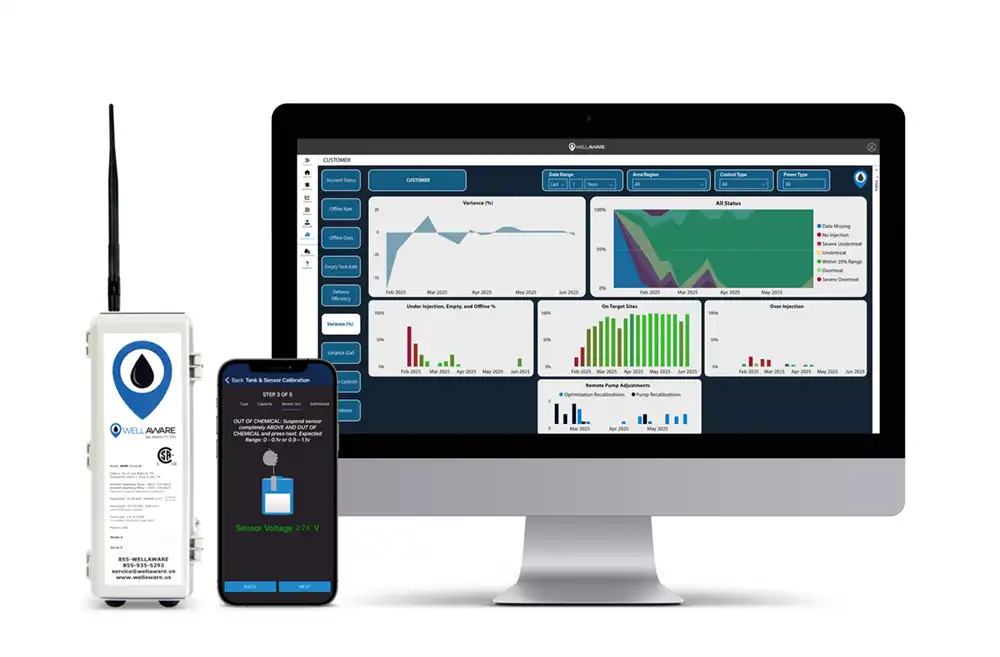
Approach B: “Use what’s already there — and control precisely” (WellAware method)
WellAware takes a simpler, more scalable, data based approach:
- Initial manual calibration at time zero
- The tank becomes the truth reference using edge analytics and temperature compensation
- Measurement improves over time using many small measurements and statistical calibration informed by WellAware’s decade+ operations
- WellAware Optimization automatically calibrates the pump as needed after assessing system variables like pump, power, and tank metrics.
- AI/ML-based anomalies and recommendations are reported to customers that address root cause system problems affecting variance.
This yields consistent performance with little to no component failure.
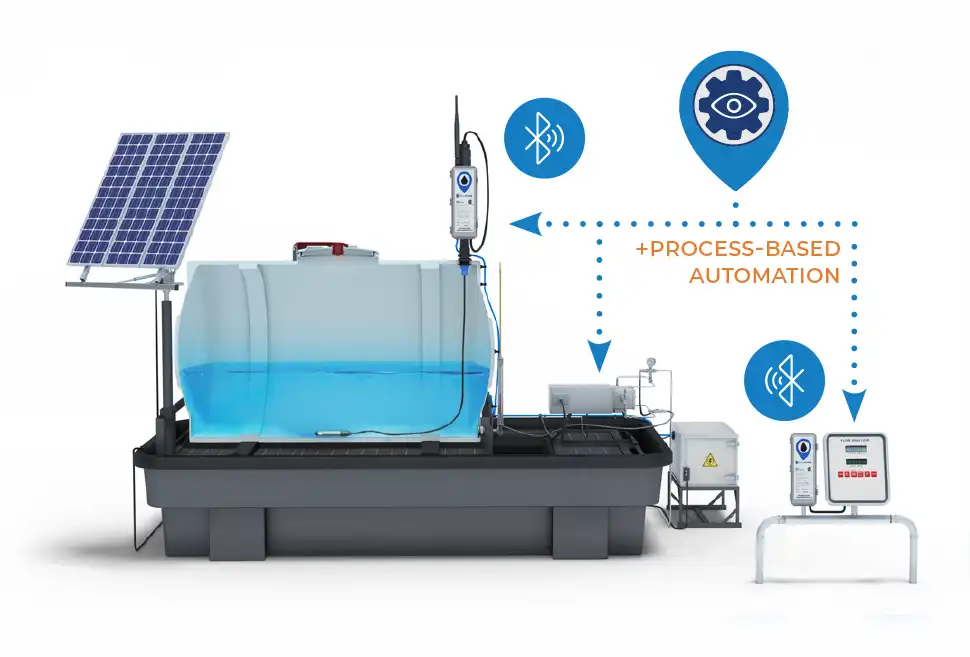
Why WellAware Wins
The tank + analytics are the best variance minimizing tools you’ll ever have
Small sight glass measurement windows amplify noise:
- Bubbles
- Switching dynamics
- Sensor drift
- Fouling effects
A tank-based method uses a much larger reference volume over longer periods, which:
- Improves signal-to-noise
- Reduces relative error
- Provides a better truth source for injection verification
- Detect leaks or injections status at the source
Fewer failure points mean higher uptime
Competitor architectures insert multiple additional failure modes:
- Solenoid sticking and timing coordination
- Sight glass fouling, plugging, leaking
- Leaks at fittings and added hardware
- Mounting, orientation and timing errors
- Hydrostatic sensor drift
- Taxing of power system due to constant power needs
WellAware removes the fragile measurement hardware and replaces it with software-driven confidence and longer-horizon truth.
Closed-loop speed control stabilizes injection variance
Measurement alone doesn’t prevent drift. Injection accuracy degrades when:
- Back-pressure changes
- Voltage fluctuates
- Viscosity shifts
- Pump motor degrades
WellAware’s closed-loop motor control maintains stable pump delivery under real-world variation.
What this means for operators
With WellAware you get:
- Higher confidence in injected volume
- Reduced system maintenance
- Fewer truck rolls
- Fine tuning pump control features
- Less system downtime from measurement hardware failures
- Greater insights across all your connected hardware
- A measurement system that improves over time instead of degrading
Bottom line
Solenoid/sight-glass systems aim to improve accuracy by adding fragile, expensive measurement hardware to harsh field environments.
WellAware solves accuracy by:
- Using the most stable measurement reference on site (the tank) coupled with edge analytics,
- Improving confidence through long-horizon averaging and calibration,
- Stabilizing injection with closed-loop control supported by AI/ML recommendation that address root cause problem impacting variance.
The result is a more scalable, lower-maintenance, higher-uptime injection measurement solution that only gets better as you use it. In addition, the data-based approach identifies system issues before they lead to downtime, notifying users of problems and prioritizing which sites they need to visit and why.