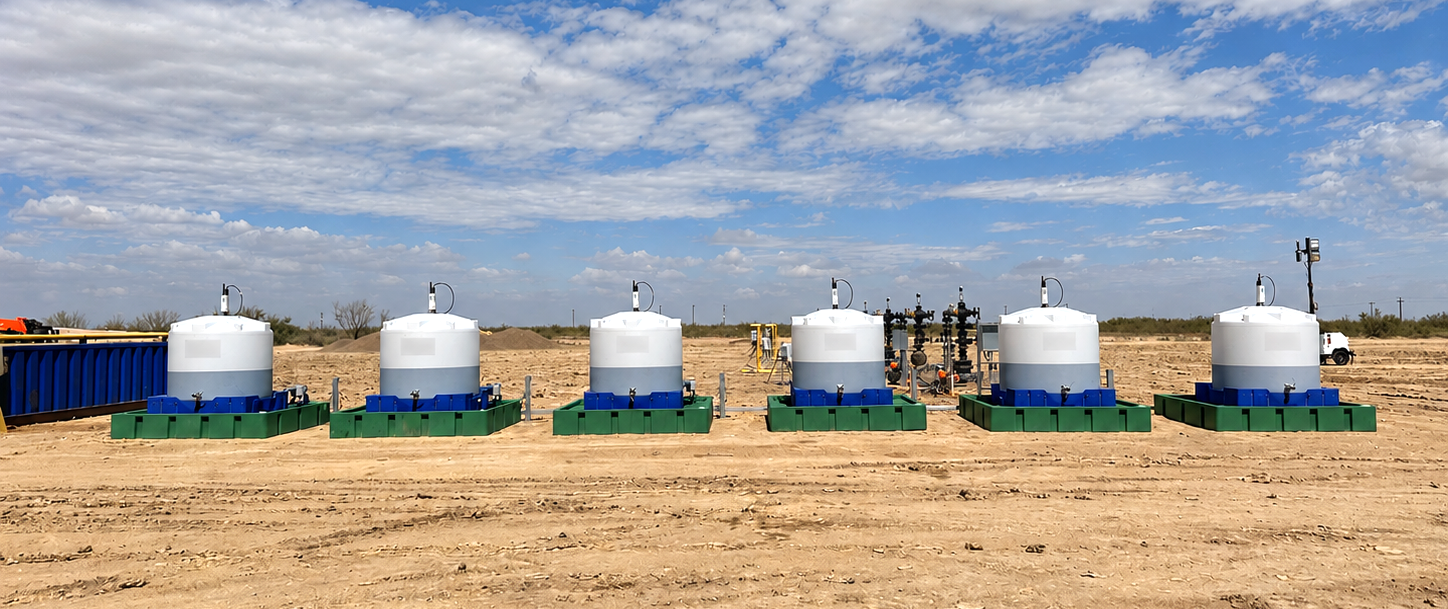
A chemical program is only as good as the treatment that actually reaches the wellbore, flowline, or pipeline. Across hundreds of distributed injection points, most operators can’t prove that it did.
Operators and chemical service providers know the pattern. Technicians drive route after route to gauge tanks and nudge pump rates. A tank runs dry over a weekend and a corrosion or scale treatment is missed for days. A pump drifts 30% off its prescribed rate as its battery ages, and nobody notices until the next sight-glass check. Chemical is overinjected on some wells and underinjected on others, while invoices are reconciled against assumptions instead of measured consumption. Pump failures are found by the driver, not the system.
The answer is a chemical injection automation platform: a single system that combines chemical tank level monitoring, injection pump diagnostics, remote pump control, and optimization software, so every injection point is measured, verified, and corrected without a truck roll. The best platforms close the loop between what the pump was told to do and what the tank says was actually delivered. This guide lays out the criteria that matter, how the approaches compare, and how WellAware implements them.
What is a chemical injection automation platform?
A chemical injection automation platform is an integrated hardware and software system that measures chemical tank levels and pump behavior at remote injection points, transmits that data to a central application, detects deviations from the prescribed treatment, and remotely or automatically adjusts injection pumps to keep chemical delivery on target.
Several components work together:
- Chemical tank level sensors measure inventory and, over time, actual consumption.
- Remote telemetry, typically cellular, moves readings from the site to the cloud.
- Injection pump monitoring tracks run status, power, and behavior.
- Pump setpoint and motor control sets the commanded rate through a variable-speed drive (VSD) or timer.
- Injection rate measurement and variance compares actual delivery with the target rate.
- Alerts and anomaly detection flag low levels, deliveries, leaks, and abnormal consumption.
- AI and predictive diagnostics identify degrading pumps and root causes before failure.
- Closed-loop control corrects the pump automatically when variance appears.
- SCADA and API integration share data and control with the systems you already run.
These capabilities fall into three tiers of maturity. Knowing which tier a vendor actually delivers is the most important part of any evaluation.
- Monitoring: see what is happening
- Supervisory control: change it remotely
- Autonomous optimization: the system corrects itself
Why traditional chemical injection monitoring falls short
Manual field operations depend on route schedules. A tank checked every week can run empty on day two. Rate checks with a sight glass and stopwatch are accurate for a moment and then decay as pump, power, and process conditions change. Every check and adjustment is a truck roll, and OSHA identifies highway vehicle crashes as the leading cause of oil and gas extraction worker fatalities.
Basic tank level monitoring removes inventory guesswork and is a real improvement. But it still can’t change anything. When consumption is off target, someone still drives out to adjust the pump.
Standalone pump controllers hold a commanded rate, but most can’t verify that the commanded rate matches delivered chemical. Pump wear, back-pressure, viscosity changes with temperature, entrained gas, and voltage sag all widen the gap between what the controller thinks and what reaches the process.
Conventional SCADA remains valuable. It is the backbone for production, safety, and facility control at many sites, and it is often the right place to supervise high-value assets. The limitation is economics and specialization: extending wired SCADA to every small injection skid is costly, and SCADA typically isn’t designed to calculate injection variance, auto-calibrate pumps, or diagnose chemical-specific faults. Modern chemical automation works best as a complement to SCADA, with read/write integration rather than replacement.
Across all four, the common gap is the same: no closed-loop corrective action based on verified delivery.
8 essential features of the best chemical injection automation platforms
1. Real-time chemical tank level monitoring
Remote chemical tank monitoring is the foundation. It provides inventory visibility, consumption trends, low-level alerts, automatic delivery detection, and projected stockout dates so routes and deliveries can be planned around real demand. Sensor selection matters: specialty chemicals can be corrosive, viscous, or prone to foaming, and hazardous locations may require Class I, Division 1 certification.
Operationally, this is what prevents missed treatments and reconciles chemical deliveries against invoices.
2. Remote chemical injection pump control
Remote pump control lets authorized users change setpoints, target dosing rates, and calibration settings from a dashboard. Platforms should support both variable-speed and timed pump interfaces, because injection fleets rarely standardize on one.
When a production engineer changes a treatment recommendation, the change should take effect in minutes across every affected well, not on the next route.
3. Closed-loop chemical injection optimization
This is the capability that separates automation from monitoring. The system compares actual injection with target, calculates variance, and corrects the pump automatically. Advanced platforms also support process-based dosing, adjusting the rate as flow, temperature, or other process variables change so the treatment ratio holds.
The critical distinction is commanded output versus verified delivery. A controller that holds a commanded stroke rate is not verifying delivery. Verification requires an independent measurement of chemical leaving the tank. WellAware uses the tank itself as the reference: a large reference volume measured over time improves signal-to-noise compared with small sight-glass windows. Our guide to accurate chemical injection variance management explains the method in detail.
4. Predictive maintenance and AI diagnostics
Pump failures rarely happen without warning. Current draw, voltage, variance patterns, and consumption signatures change as pumps degrade, lines plug, or air-lock conditions develop. AI diagnostics turn those signals into specific, actionable findings such as suspected blockage, failing motor, power irregularity, or abnormal consumption that may indicate a leak.
The value is shifting maintenance from reactive callouts to planned work, and preventing the untreated days that follow an unnoticed failure.
5. Reliable remote connectivity
Injection points are often solar-powered sites with no wired communications. Field devices need low power draw, multi-carrier cellular connectivity, rugged enclosures, and fast installation that doesn’t require an electrician. Equally important is edge intelligence: the device should continue sampling, controlling, and storing data during a communications outage.
6. Centralized chemical program visibility
Chemical program optimization software should show every injection point in one portfolio view, prioritize alarms by consequence, and support management by exception so teams spend time only where something is wrong. A shared view between the producer and the chemical service provider reduces disputes over deliveries and treatment rates because both parties see the same data.
7. SCADA and system integration
Chemical injection data shouldn’t live in a silo. Look for read/write integration with SCADA and historians, industrial protocols such as Modbus, and REST API or file export for data warehouses and analytics. Cybersecurity belongs in this conversation too. The ISA/IEC 62443 series is the consensus framework for securing industrial automation and control systems and a useful reference point for vendor reviews.
8. Measurable ROI and scalability
Value should be measurable in chemical savings, fewer field visits, avoided stockouts, and lower maintenance expense. Just as important is scale: the economics must hold from a ten-well pilot to thousands of injection points, with deployment, calibration, and support that don’t grow linearly with headcount.
Chemical tank level monitoring vs. full chemical injection automation
The table below compares typical capabilities by approach. Individual products vary, so treat it as a framework for questions rather than a verdict on any specific vendor.
| Capability | Manual monitoring | Tank level monitoring only | Remote pump control | Integrated closed-loop automation |
|---|---|---|---|---|
| Inventory visibility | Periodic | Continuous | Varies | Continuous |
| Remote setpoint changes | No | No | Yes | Yes |
| Actual injection verification | Spot checks | Inferred | Commanded rate | Measured vs. target |
| Fault detection | On-site only | Level anomalies | Pump status | Tank, pump, and power |
| Automated corrective response | No | No | Limited | Auto-calibration |
| Chemical program optimization | No | Trend data | Manual | Process-based |
Which approach fits? Tank level monitoring alone can make sense for bulk storage, low-criticality treatments, or batch-treated sites where rate precision matters less. Remote pump control fits operations where engineers change rates frequently but verify delivery through other means. For continuous treatments where under-treatment carries integrity or production risk, such as corrosion, scale, paraffin, and hydrate inhibition, integrated closed-loop automation is the stronger fit.
Not sure where your sites fall? Map your injection points against this framework with a WellAware specialist.
Talk to a chemical automation specialistHow WellAware combines tank monitoring, chemical injection control, and AI
WellAware is built around monitoring + control + intelligence on one platform, rather than a tank sensor with a dashboard bolted on. Three layers work together:
 Scout
Monitor
Remote monitoring, chemical tank level visibility, consumption tracking, alarms, and anomaly detection. Battery life of 5+ years, Class I Div I certification, and a 10-minute bolt-on install.
 Commander
Control
Everything Scout does, plus remote setpoints, real-time variance tracking, automatic calibration, power compensation, and flow-based control for VSD or timed pumps.
 WellAware AI
Optimize
Predictive diagnostics across tank, pump, power, and valve subsystems, with specific recommendations and fleet-level visibility.

Documented strengths relevant to chemical programs include:
- Low-power, wireless field deployment on solar or AC power, with multi-carrier LTE connectivity.
- Pump output variance management using the tank as the truth reference, with temperature compensation.
- Automatic calibration and power compensation that hold setpoints despite aging batteries, voltage sag, or solar intermittency.
- Process-based injection optimization that adjusts to real-time flow, temperature, and process conditions.
- SCADA and API integration, including Modbus TCP/RTU, read/write integration with systems such as Ignition, Wonderware, and OSIsoft PI, plus REST API, MQTT, and SFTP. See all integrations.
- Edge intelligence that keeps sampling, alerting, and controlling when connectivity drops.
- A shared operational view for producers and chemical service providers.
In practice, the workflow looks like this:
Sensor readingAnomaly detectedAutomated or recommended responseVerified delivery
Field example: On a solar-powered corrosion inhibitor skid, several cloudy days lower battery voltage and the pump begins to under-deliver. Tank consumption falls below the expected curve and variance appears. Commander compensates for the power change and recalibrates to restore the target rate. If variance persists, WellAware AI flags a likely root cause, such as a suspected suction blockage, and recommends a specific maintenance action. The tank trend then confirms whether delivery returned to target.
Capabilities depend on hardware configuration. Scout samples at 1-hour or 5-minute intervals; Commander samples at 5-minute intervals or less and is required for closed-loop control.
Real-world oilfield chemical automation applications
Automation verifies that chemical is delivered at the prescribed rate. Treatment effectiveness still depends on chemical selection, residual testing, coupons, and other field measurements.
- Corrosion inhibitor injectionContinuous inhibitor film depends on uninterrupted dosing. Chemical inhibitors are one of the primary corrosion control methods identified by AMPP.
- Scale inhibitor injectionUnder-dosing allows deposits that restrict flow and can require costly remediation. Rates often need to follow produced water volumes.
- H2S scavenger treatmentDosing must track gas volumes and H2S concentration. Overdosing wastes expensive chemical; underdosing risks specification and safety exposure.
- Methanol and hydrate preventionDemand spikes with temperature. A dry methanol tank during a cold snap can mean a freeze-off and lost production.
- Paraffin and flow assuranceConsistent treatment prevents wax buildup that drives hot-oiling and workover costs.
- Biocide and microbial treatmentBatch and continuous programs control microbially influenced corrosion and souring, so schedule adherence matters.
- Produced water treatmentDosing must follow variable flow rates to hold water quality targets for disposal or reuse.
- Pipeline chemical managementLong distances and many injection points make remote verification essential for integrity programs. See how WellAware supports oilfield chemical programs.
The ROI of chemical injection automation
A chemical automation platform changes program economics through reduced overinjection, fewer manual tank inspections, fewer truck rolls for routine adjustments, better-planned deliveries, fewer unexpected pump failures, lower risk of treatment interruption and under-treatment, and more productive field staff.
WellAware has reported the following results across chemical injection deployments:
WellAware-reported results from chemical injection deployments. Results vary by operation and are not guaranteed. In one pipeline customer story, WellAware reports a 31% reduction in chemical program spend.
A sample ROI framework
Use the following equations with your own validated inputs:
Annual chemical savings = baseline annual chemical spend × validated reduction %
Field visit savings = avoided annual trips × fully burdened cost per trip
Net annual benefit = chemical savings + field visit savings + other substantiated benefits − incremental annual platform cost
Payback period = initial deployment investment ÷ net annual benefit
Illustrative example (assumptions, not a quote): a 100-well program spends $1,200,000 per year on chemical. A validated 10% reduction yields $120,000. Avoiding 2,000 routine trips at a $75 burdened cost yields $150,000. Against a hypothetical $90,000 in annual platform cost, net annual benefit is $180,000.
Limitations: don’t double-count. If avoided trips are counted as labor savings, don’t also count the same technician hours as productivity gains. Treat avoided workovers and production protection separately, and only with historical evidence. Validate the reduction percentage in a pilot before scaling assumptions. For a deeper look at how data becomes measurable value, read From Raw Signals to Real ROI.
Model your own program. Plug in your wells, chemical spend, and route costs.
Calculate your chemical automation ROIHow to select the best chemical injection monitoring and automation vendor
Use this checklist in vendor conversations and pilots:
- Does the system measure actual chemical consumption, or rely solely on commanded pump rates?
- Can our existing injection pumps be monitored and controlled?
- Is tank level monitoring part of the same system?
- Can automation compensate for changing power, temperature, and process conditions?
- What happens during a communications outage?
- How does the system identify and correct injection variance?
- Can operators and chemical service providers access a shared operating view?
- What is the process for installation, calibration, and maintenance?
- What integrations and data export options are supported?
- What is the expected total cost of ownership?
- What evidence supports claimed savings and operational improvements?
Beyond features, weigh deployment complexity (added hardware such as solenoids and sight-glass columns creates more failure points), sensor compatibility with your chemistries, implementation support from people who have worked on injection skids, data ownership and export rights, and operational cybersecurity practices aligned with recognized frameworks.
Frequently asked questions about chemical injection automation
What is the best chemical injection automation platform for oil and gas?
The best platform is the one that verifies actual delivery and corrects it automatically, not just one that reports tank levels. Evaluate platforms on closed-loop control, measured variance, compatibility with existing pumps, edge reliability, SCADA integration, and evidence behind ROI claims. WellAware combines all of these on a single platform.
How does remote chemical tank level monitoring work?
A sensor measures liquid level in the tank and a field device transmits readings over cellular or another network to a cloud application. Software converts level to volume using the tank’s geometry, then tracks consumption, detects deliveries, and sends alerts when levels or usage fall outside expected ranges.
Can chemical injection pumps be controlled remotely?
Yes. With a controller connected to the pump’s VSD or timer, authorized users can change rates, setpoints, and calibration from a dashboard or SCADA. Remote control should be paired with permissions and change logging so every adjustment is accountable.
How does AI optimize chemical injection rates?
AI compares expected and actual consumption, identifies variance patterns, and correlates them with pump, power, and process data. It can recommend or trigger recalibration, flag root causes like blockages or failing motors, and help engineers set rates based on actual process conditions.
Can an automation platform work with existing chemical injection pumps?
Often, yes. WellAware Commander supports VSD and timed pump interfaces, so many existing pumps can be automated without replacement. Compatibility should be confirmed during site assessment.
What is the difference between chemical injection monitoring and automation?
Monitoring tells you what is happening. Automation acts on it. A monitoring system reports tank levels and alarms; an automation platform also adjusts pumps remotely and, with closed-loop control, corrects variance on its own.
How much can chemical injection automation reduce operating costs?
It depends on your baseline. WellAware reports a 27% reduction in chemical spend and 52% fewer field visits across chemical injection deployments, but results vary. The most reliable estimate comes from your own data and a pilot with defined success criteria.
Does chemical automation integrate with existing SCADA systems?
A capable platform should. WellAware supports Modbus TCP/RTU and read/write integration with SCADA systems including Ignition, Wonderware, and OSIsoft PI, plus REST API, MQTT, and SFTP.
Why WellAware is a strong choice for integrated chemical automation
Measured against the criteria in this guide, WellAware covers the full stack: real-time tank level monitoring with Scout, remote and closed-loop pump control with Commander, tank-referenced variance management with automatic calibration and power compensation, AI diagnostics that turn anomalies into specific actions, edge reliability for solar-powered sites, SCADA and API integration, and a shared view that aligns producers and chemical service providers.
That combination of monitoring, control, and intelligence is what moves a chemical program from assumed treatment to verified treatment.
See how WellAware can optimize your chemical injection program
Get a personalized demonstration built around your injection points, chemistries, and pumps. We’ll show you how Scout, Commander, and WellAware AI work together and help you scope a measurable path from monitoring to closed-loop automation.
Stop assuming treatment. Start verifying it.
Sources